
December 2001 marked the end of the road for one of Ford’s most controversial vehicles. American-made, the Explorer was not to Europeans’ tastes.
It conjured images of a gas guzzler more at home on highways than quiet byways, so the decision to kill it off did not come as a surprise when bosses at the Blue Oval announced that they had had a rethink.
Fast forward two-and-a-bit decades and the nameplate is back. This time, however, it has been engineered and styled with Europeans squarely in mind. And there is not a diesel or petrol engine in sight as they step aside for battery technology supplied by Volkswagen as part of a venture that involves Ford re-badging some of the German firm’s passenger-carrying models, while VW will do the same with several of Ford’s commercial vehicles.
In short, Ford is marketing the reimagined Explorer at those people who want everyday usability, strong range and a relaxing ride. Sitting at the heart of the line-up, in-between ‘Style’ and ‘Premium’ is ‘Select’ as tested here. Available in Extended Range only, our car’s 77kWh battery feeds a 286bhp motor positioned on the back axle for a claimed real-world range of 374 miles. Performance depends very much on which Explorer you choose: the entry-level rear-drive model produces 168bhp and opting for the dual-motor setup ups total power to 340bhp, though the trade-off is a 70kg weight penalty. The 0–62mph sprint times come in at 8.7 seconds, 6.4 seconds and 5.3 seconds respectively, with the extra motor best viewed as a traction upgrade rather than a dramatic boost in real-world pace.
Under the skin, the Explorer shares its underpinnings with Volkswagen’s MEB platform – the same electric architecture that underwrites cars like the ID.4. Ford has retuned the steering, suspension and handling to feel more bespoke, giving the Explorer a character and driving feel that’s distinctly more Ford-like than simply a rebadge exercise. Charging performance is competitive, with a DC rapid charger pushing the battery from 10 to 80% in a snip under half-an-hour, meaning a short stop can restore a useful chunk of range. At home, meanwhile, overnight charging is achievable in six hours if using an 11kW wallbox.
On the road, the Explorer adopts the softer, more composed approach that many buyers expect from a family SUV. The rear-wheel-drive layout helps deliver a balanced feel and, while the steering favours stability over sharpness, it is both predictable and confidence-inspiring once you adjust to its circa two-tonne kerb weight. Suspension tuning prioritises comfort over sportiness, absorbing imperfections and smoothing out longer motorway journeys. Hustle the Explorer and body roll becomes more apparent through bends and corners, though the position – and weight – of the battery does keep it planted to the road, helped by big tyres and the absence of power-on understeer.
Inside, the Explorer’s cabin, with its VW-common stalks, driver display and fonts, has a clean and modern look about it. The focal point’s a 15-inch portrait touchscreen that runs a much-improved version of the Volkswagen Group’s infotainment system, with decent graphics, smartphone integration, and connected navigation that is capable of planning EV-friendly routes. The menu structure is easy to understand, though it is frustrating that climate functions have to be made through it as opposed to a panel of physical buttons.
One really clever feature of the pivoting screen is how it acts as a lid for a little cupboard behind, so that space is covered when the screen is lowered. Other storage for smaller stuff includes a removable cupholder that clips either on top of the console, or below it to free up a laptop-sized bin. Wireless phone charging, heated front seats and multiple USB-C ports for keeping handheld devices topped up are standard on ‘Select’ Explorers, making it intuitive to use every day. Space is a genuine strength, too.
Rear passengers benefit from ample legroom, while the boot is generous for a five-seat SUV, easily accommodating luggage for a weekend away or the paraphernalia of family life. A useful load-through hatch adds flexibility when carrying longer items, and practical storage solutions are found throughout the cabin – from deep door bins to a huge centre console. As for the overall ambience, the look is clean and well finished, feeling a step above more basic EV interiors. While there is no room for a charge cable in the front boot – otherwise known as the ‘frunk’ – the Explorer is still accommodating, the boot weighing it at 470-litres if the second row of chairs are occupied.
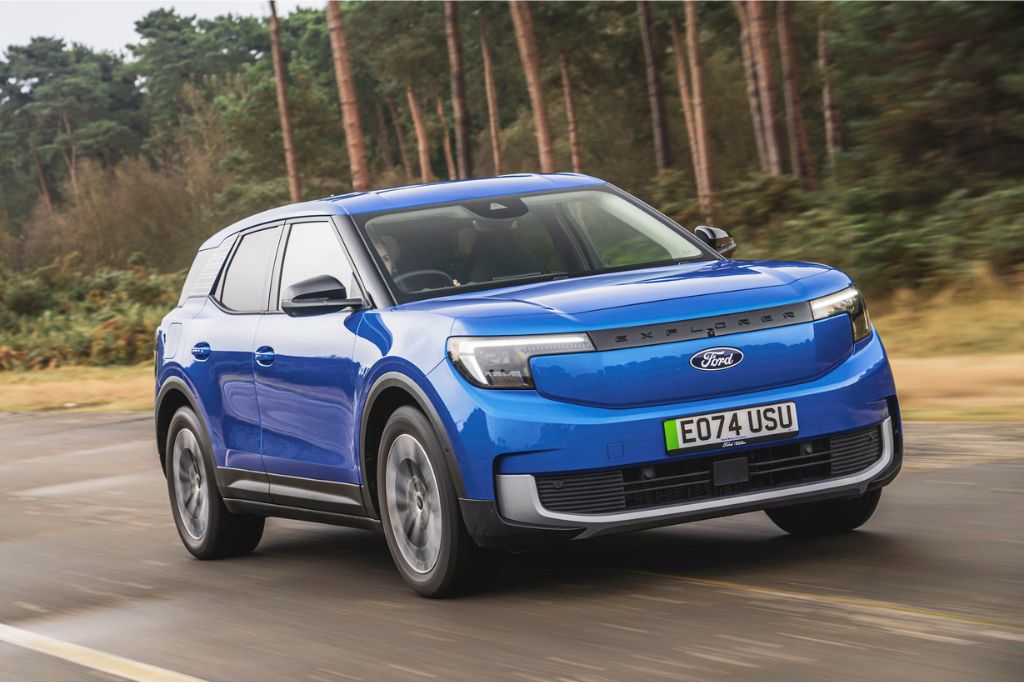
Visually, there is little to separate ‘Style’ and ‘Select’ models as both sit on the same 19-inch alloys, growing to 20-inches on ‘Premium’. Another giveaway is the Matrix LED lights that have an automatic dip beam function, and panoramic sunroof. If you can live without these then opt for ‘Select’ as it boasts a 7-speaker audio system with soundbar, 12-way Power Driver seat with memory and massage function, heated front seats and steering wheel, adaptive cruise control as well as lane keeping aid and lane departure warning, a rear-view camera, and front and rear parking sensors. As for body colours, there are just six to choose from – white, black, grey, red, and two hues of blue: ‘Arctic Blue’ and ‘Blue My Mind’.