
Electric Vehicles have never been slow. Even modest battery-powered examples guarantee pleasing performance, but where they do trail their petrol and diesel counterparts is enjoyment. That applies, of course, unless you have £65,000 to spend on Hyundai’s IONIQ 5 N, or £105,000 resting in your bank account for Porsche’s Taycan.
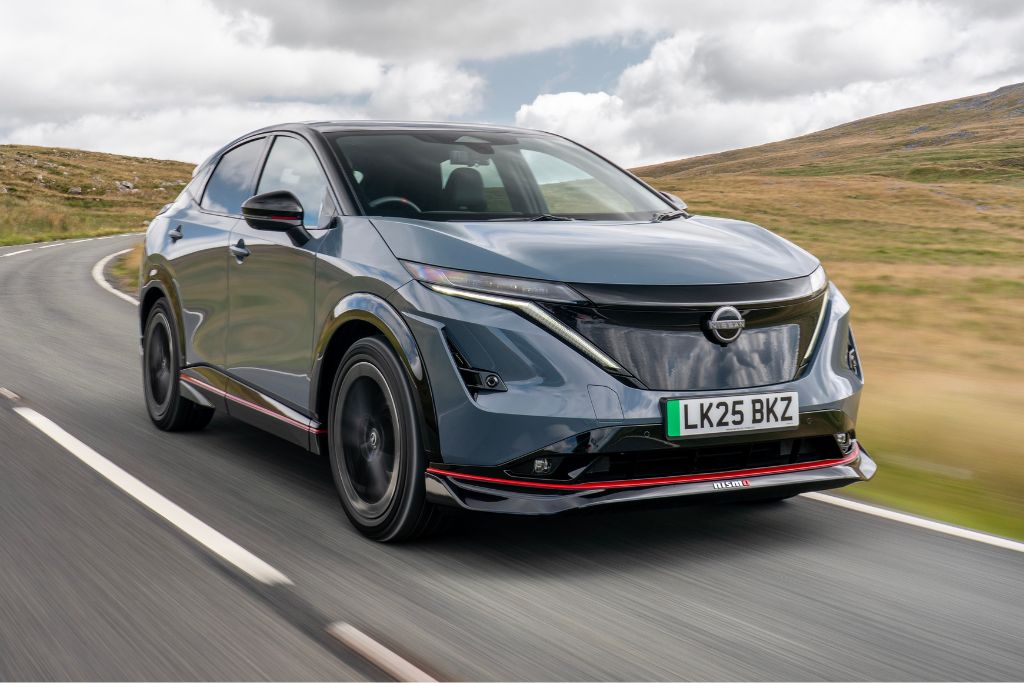
Or how about Nissan’s five-seat Ariya SUV, which has been placed under the microscope of its motorsport arm? The name may not be as common as Ford’s ST or RS, Vauxhall’s GSI or Volkswagen’s GTI, but anything Nismo has put its name to has tended to make for a strong proposition. What we have here, then, is a two-plus tonne car that gains an additional 128bhp to push total power to 429bhp and a more rear-biased torque split for an all-wheel-drive system that is attached to a sports-tuned suspension that adopts stiffer springs and dampers and revised stabilisers to help dial out body roll.
Getting from zero to 60mph is as fast as Nissan quotes (5 seconds dead) and a full charge of the 87kWh battery is capable of 261-miles depending on how heavy your right foot is. Nismo badging can be found on every corner of the Ariya, which is 4.59 metres long and 1.85 metres wide. It was not exactly a shrinking violet before so this makeover that consists of a new front and rear bumper with red pin stripe, deep chin spoiler to reduce lift by 40%, pronounced boot lip and extended roof-mounted spoiler ensure it is harder to miss. Wrapped in Michelin Pilot Sport rubber, the twenty-inch cast aluminium lightweight alloys are smart but seem lost in those over-sized wheel arches. All of this can be yours for a shade under £57,000.
Originally, customers had the one colour option –Nismo Stealth Grey – but this has been expanded to now include ‘Stealth Grey’ and ‘Gun Grey’, ‘Pearl Black’ and finally ‘White Pearl’. The dark theme is repeated on the inside of a largely unchanged cabin, save for red stitching, red accents, black headlining, Nismo branding, and a specific Nismo startup sequence for the driver’s display – a pair of side-by-side 12.3-inch units. The infotainment display is quick to process requests and can be tailored to by dragging and dropping tiles. Other pluses include 4G connectivity and over-the-air-updates to keep software current.
A small row of backlit heating and ventilation buttons on the band of wood-effect material below it provides haptic feedback to confirm your selection. And then we get to the centre console which, at the press of two buttons on its shoulder, can be moved forward electronically to free up additional space if the middle seat passenger in the rear is particularly tall, or backwards to maximise the totally flat floor area that exists in the front. All told, the Ariya is easily the biggest push in craftsmanship Nissan has enjoyed for a considerable time as everything looks and feels premium – exactly as you want it to be.
Now comes the crunch: how does the Ariya Nismo point and steer? Put mildly, it is quite a letdown, judged in isolation and against what this version is supposed to rival. The standard Ariya already leans toward the firm side – and this is compromised further. You cannot but fail to notice how restless the ride is on reasonably smooth roads as it bobs along; perhaps if adaptive dampers were added the mix, the result would be a lot different.
Undoubtedly it would make for a more engaging drive; the steering has a fair amount of weight to it but lacks meaningful feedback and so makes for a less-than-exciting experience. There are a handful of drive modes to choose from and flicking it into ‘Nismo’ sharpens the throttle response and regenerative braking system – and pumps a sythesised engine note that is intended to mimic the whine of an electric motor into the cabin. How much regeneration you want varies depending on the drive mode, and whether you have chosen ‘D’ or ‘B’ and whether you have turned on the Nissan-specific ‘e-Pedal’.
Space in the Ariya is so plentiful you can expect to accommodate five adults and their belongings with room to spare. When the centre of the 60/40 folding rear seat is unoccupied the armrest can be lowered but, oddly, there is no ski hatch that allows longer objects to be carried safely in transit. Again, this is a feature in non-Nismo badged Ariyas. The sheer width mentioned earlier should come into its own as far as the boot is concerned, yet that is not necessarily the case as front-wheel-drive models have 466-litres of storage – a figure trumped by Skoda’s Enyaq (585-litres). The presence of a subwoofer does away with a height adjustable boot floor and eliminates the possibility of using the three moveable board sections to create partitions to set objects or shopping in securely.
The centre console between the driver and front seat passenger cannot, on Nismo iterations at least, be inched forward – or backward – at the press of a button to the convenience of those travelling shotgun or in the second row. There is, however, lots of space to place phones, keys and wallets, and the door bins are a sensible shape and useful size for swallowing water bottles or coffee travel cups.