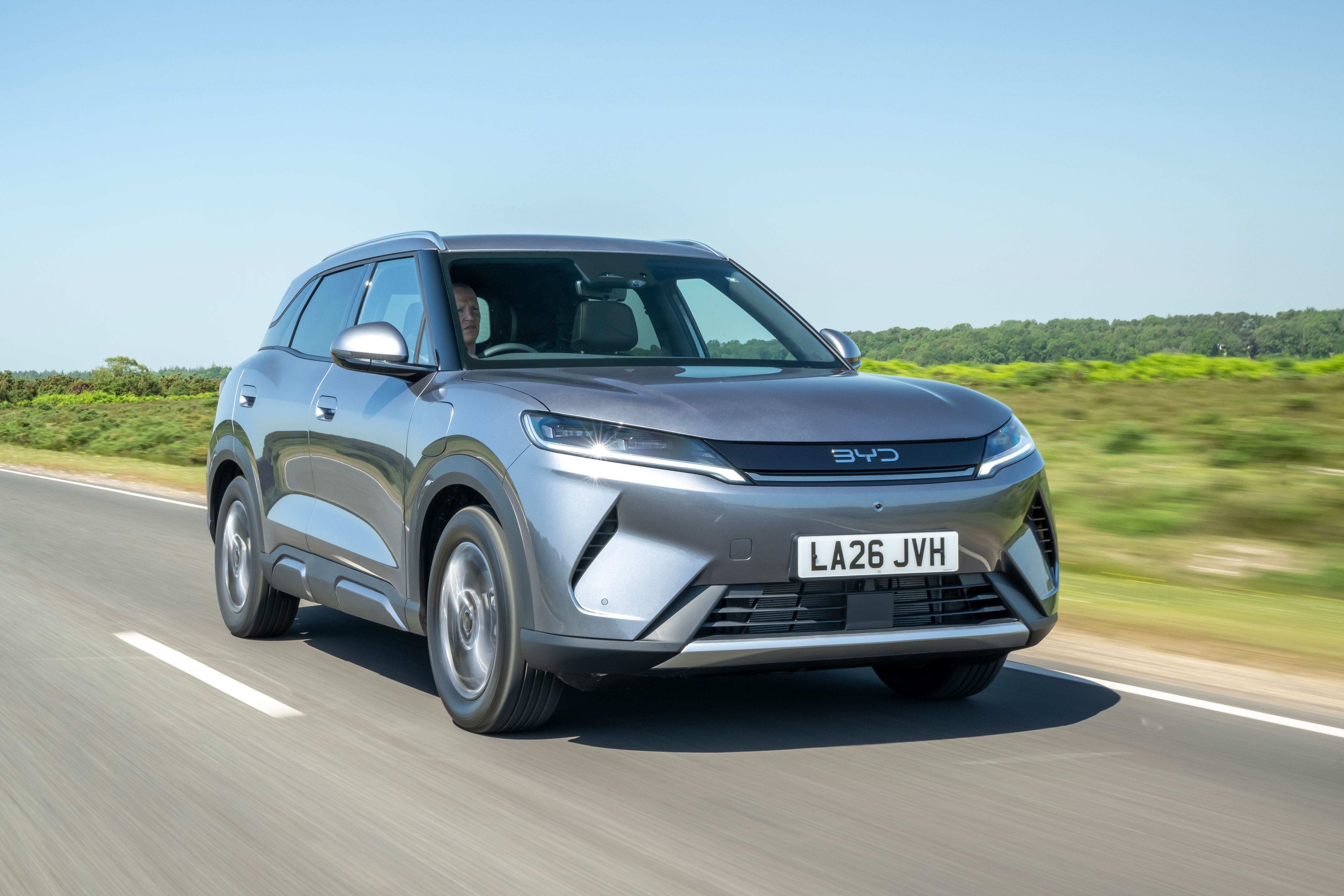

BYD’s rapid expansion across the UK market shows no sign of slowing – and the latest addition to its growing line-up is the Atto 2, a compact SUV that is an interesting proposition.
Rather than following the increasingly crowded route of going fully electric, its ‘DM-I’ powertrain combines a 1.5-litre petrol engine with electric motors and a plug-in battery, offering the potential for most daily journeys to be completed on electric power while retaining the convenience of petrol for longer trips. It is a system that could make sense for buyers wanting to reduce their reliance on petrol without making the complete leap to an all-Electric Vehicle.
Visually, the Atto 2 is unlikely to turn too many heads; its styling is inoffensive rather than distinctive, with an all-too-familiar small SUV silhouette comprising slim LED lighting and chunky lower bodywork that give it a contemporary appearance without making it particularly memorable. Those after something less understated should avert their gaze toward the Renault 4 or Ford Puma as these offer considerably more visual character.
Inside, things are more appealing. Build quality is strong and the choice of materials is generally good, giving the cabin a more upmarket feel than some of its price rivals. There are harder plastics lower down, but it is well assembled, and there is plenty of space for passengers considering the Atto’s relatively compact dimensions. Technology, however, is a mixed bag. The central touchscreen is sharp and responsive, with clear graphics, but BYD has placed too much emphasis on what – and how – functions are controlled through it. Too many everyday choices have been moved onto the display, from adjusting the headlights to opening and closing the panoramic sunroof blind.
It is an increasingly common criticism of modern cars, but the Atto 2 demonstrates why physical controls still have their place. A touchscreen is perfectly suited to navigation, media and perhaps more complex vehicle settings, but when a driver has to work through a menu to perform simple tasks, the technology becomes an inconvenience – and not advantage. The sound system is another disappointment; it has a distinctly tinny character which feels at odds with the otherwise solid and well-presented interior. If you are a streaming junkie who relies on crisp sounding audio, you are not going to find it here.
Fortunately, the standard equipment list goes some way toward making up for these very annoying shortcomings. As with other BYD models, the Atto 2 is generously equipped, with higher-spec versions offering features such as a panoramic roof, heated seats, a heated steering wheel, wireless charging and a 360-degree camera. As for practicality, the rear seats offer good levels of headroom and legroom, while the 425-litre boot is a useful size, though smaller than the Puma’s 456-litre offering. Storage around the cabin is also plentiful, reinforcing the Atto 2’s credentials as a practical everyday car.
Arguably, the real interest, however, lies beneath the bonnet. The DM-i system is designed to make the most of electric power, and with charge in the battery the Atto 2 feels much like an EV around town. The petrol engine can remain in the background for much of the time, while transitions between the various power sources are generally smooth and unobtrusive.
Customers can choose between ‘Boost’ that comprises a 51.1kWh battery and a 177bhp electric motor for a 0–62mph time of 7.9 seconds and a WLTP range of up to 214 miles or the ‘Comfort’ model that runs a larger 65kWh battery and 203bhp motor. Together, this extends the WLTP range to as much as 267-miles. Both versions come with a heat pump as standard, helping to preserve electric range during the colder months.
For those able to charge at home, this could be one of the Chinese car’s biggest strengths: shorter journeys can be completed using electric power alone, while the petrol engine removes the need for lengthy charging stops on longer trips.
There is plenty of performance, too, although the Atto 2 is better described as brisk rather than quick. Ask for maximum acceleration and there can be a noticeable pause before the powertrain gathers everything together. It is not a problem during normal driving, but the car responds better to a smoother approach than it does to being driven aggressively.
The ride is more problematic. Around town, the suspension can feel decidedly crashy, at low speeds, over broken surfaces and sharp-edged bumps. Potholes and imperfections are transmitted into the cabin with more force than expected, which is disappointing for a family-oriented SUV. It becomes more convincing as speeds increase. On the motorway the suspension settles down and the car settles, making it a relaxed and stable long-distance cruiser. Adaptive cruise control adds to that sense of ease, although wind and road noise mean it isn’t quite as refined as the best in class.
Perhaps unsurprisingly, the Atto 2 is not intended to be an out-and-out enthusiast’s car, so there is little reason to seek out a twisty road simply for the enjoyment of driving it – particularly as the steering is unnecessarily heavy and completely devoid of feel.